
Building the Future of Vision Research
In Hamilton
An estimated 3.5 million Canadians are living with either age-related macular degeneration (AMD) or diabetic retinopathy (DR) – two common medical conditions that can lead to vision loss. Our current treatments can slow vision loss but it cannot be reversed, making early detection, diagnosis and intervention critical.
AMD is characterized by the deterioration of the middle part of the retina, called the macula, and can result in a loss of clear, detailed central vision. DR is a complication of living with diabetes and can result in damage to the blood vessels in the retina leading to spots in a patient’s vision. For both diseases, retinal imaging is crucial to their detection, diagnosis and the monitoring of treatment effectiveness.
Retinal imaging technology plays a key role in effective and early diagnosis. However, diagnostic imaging equipment for ophthalmology is not funded by the operating dollars hospitals receive from the province.
In 2022, Thomas Kevill had just recovered from a surgery to repair a detached retina. Pleased with the restoration of his sight, Kevill struck up a conversation with his surgeon, now city-wide chief of Ophthalmology, Dr. Varun Chaudhary (pictured right).
During that chat, Kevill learned more about the care provided at the Hamilton Regional Eye Institute at St. Joe’s King campus, and the research pursued there too. He also learned about the funding needed for key diagnostic imaging equipment. Not long after, Thomas Kevill donated $200,000 to help the Hospital purchase an Optical Coherence Tomography (OCT) scanner – the “gold standard” in retinal imaging devices.
“When I learned from Dr. Chaudhary that the Eye Institute needed an upgraded OCT scanner to be eligible for clinical trials that would help patients, like me, I didn’t hesitate to give back to the Hospital that restored my vision,” said Kevill.

With this new tech, St. Joe’s was able to help patients like Kevill who are experiencing retinal issues, while also engaging in international research studies aimed at helping those experiencing vision loss due to macular degeneration and diabetic retinopathy.
Kevill continued to stay abreast of Dr. Chaudhary’s vision research, and one year later he made a $250,000 donation to help establish a new Vitreoretinal Imaging Lab to create a dedicated space for vision research.
In the summer of 2024, Mr. Kevill made yet another gift – a new $600,000 donation. The donation is funding new equipment as well as a dedicated research staff member to help further cement St. Joe’s leadership in retinal disease patient care, research and innovation. In recognition of more than $1,000,000 in cumulative support, the new research laboratory was named the Thomas Kevill Advanced Vitreoretinal Imaging Lab.
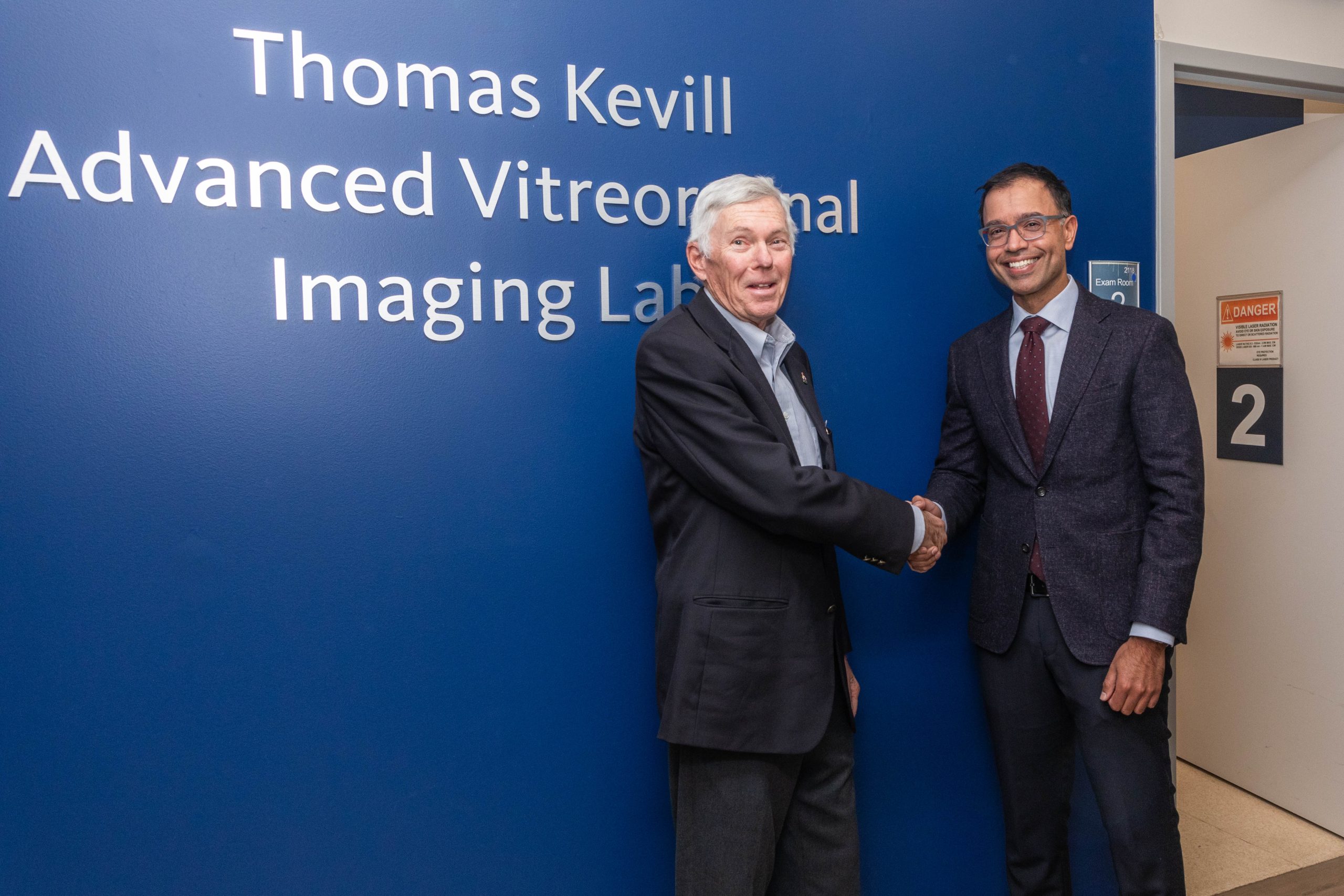
“Our team is hard at work analyzing volumes of highly-detailed retinal imaging to identify important biomarkers that can predict disease progression and patient responses to treatment,” said Dr. Chaudhary. “The ultimate goal is to enhance patient outcomes for those living with Age-Related Macular Degeneration and Diabetic Retinopathy.”
An Inspiring Update
Since preparing this story for our 2024-2025 annual report, St. Joseph’s Healthcare Foundation has announced another incredible gift for eye research from Thomas Kevill. In September 2025, Kevill donated $10 million to accelerate groundbreaking research aimed at combating AMD and diabetic retinopathy, using artificial intelligence to speed up diagnoses, identify biomarkers to predict disease development and deliver personalized medicine.
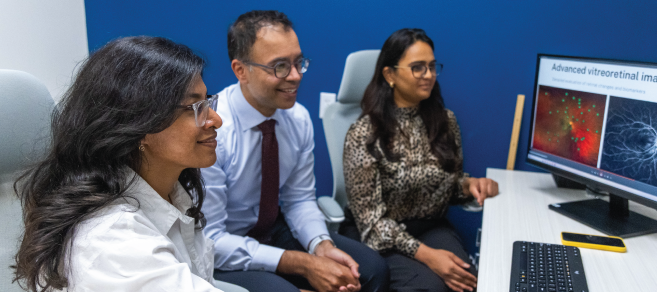
“These conditions place a significant burden on our healthcare system and on the lives of the patients living with vision loss because of them,” said Dr. Lehana Thabane, vice-president, research, St. Joseph’s Healthcare Hamilton. “We’re grateful to Mr. Kevill for his remarkable gift that will allow us to focus our research efforts on finding ways to prevent these conditions from taking away the precious gift of sight.”
In recognition of his incredible generosity, the regional eye institute at St. Joe’s King Campus will henceforth be known as the Thomas Kevill Regional Eye Institute.